


Atmospheric Aerosols in Extreme Environments: A Journey from the Himalayas to the Poles and Oceans
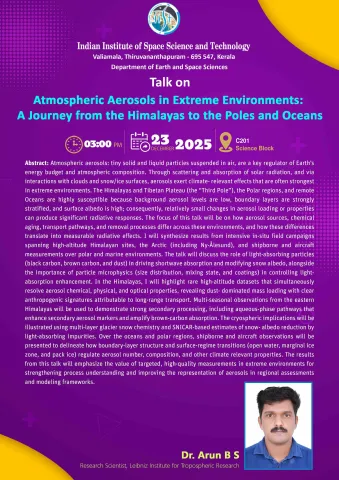
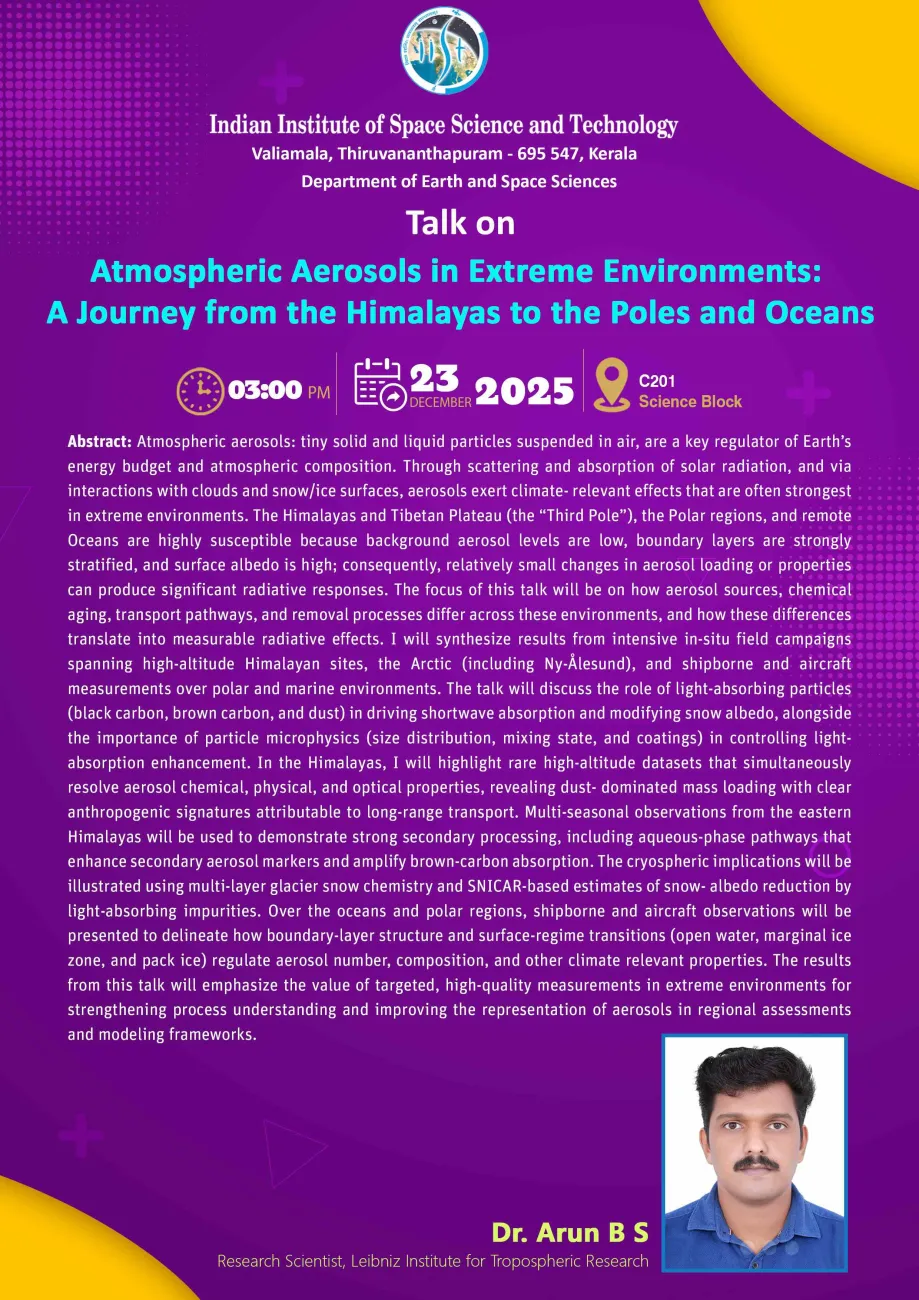
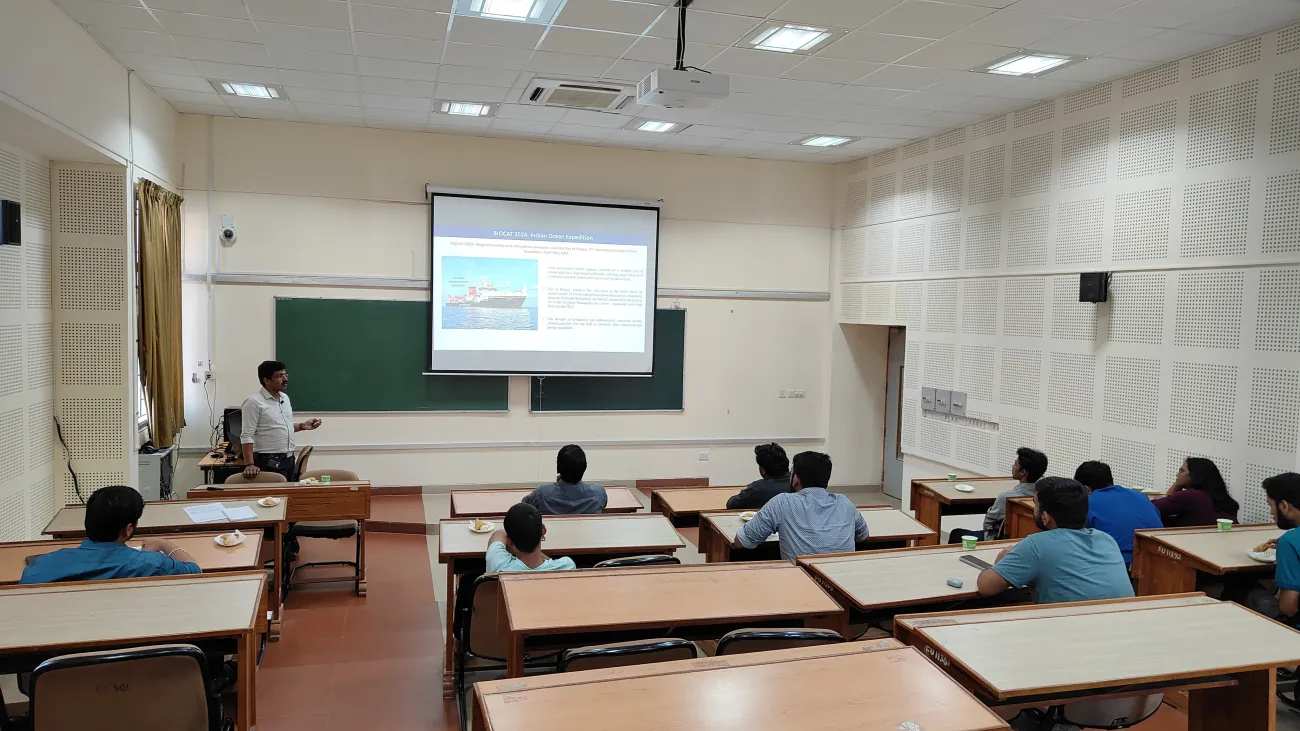
Dr. Arun B. S., Research Scientist at the Leibniz Institute for Tropospheric Research (TROPOS), Leipzig, Germany, will be visiting IIST and will deliver a departmental seminar titled “Atmospheric Aerosols in Extreme Environments: A Journey from the Himalayas to the Poles and Oceans.”
Atmospheric aerosols: tiny solid and liquid particles suspended in air, are a key regulator of Earth’s energy budget and atmospheric composition. Through scattering and absorption of solar radiation, and via interactions with clouds and snow/ice surfaces, aerosols exert climate- relevant effects that are often strongest in extreme environments. The Himalayas and Tibetan Plateau (the “Third Pole”), the Polar regions, and remote Oceans are highly susceptible because background aerosol levels are low, boundary layers are strongly stratified, and surface albedo is high; consequently, relatively small changes in aerosol loading or properties can produce significant radiative responses. The focus of this talk will be on how aerosol sources, chemical aging, transport pathways, and removal processes differ across these environments, and how these differences translate into measurable radiative effects. I will synthesize results from intensive in-situ field campaigns spanning high-altitude Himalayan sites, the Arctic (including Ny-Ålesund), and shipborne and aircraft measurements over polar and marine environments. The talk will discuss the role of light-absorbing particles (black carbon, brown carbon, and dust) in driving shortwave absorption and modifying snow albedo, alongside the importance of particle microphysics (size distribution, mixing state, and coatings) in controlling light- absorption enhancement. In the Himalayas, I will highlight rare high-altitude datasets that simultaneously resolve aerosol chemical, physical, and optical properties, revealing dust- dominated mass loading with clear anthropogenic signatures attributable to long-range transport. Multi-seasonal observations from the eastern Himalayas will be used to demonstrate strong secondary processing, including aqueous-phase pathways that enhance secondary aerosol markers and amplify brown-carbon absorption. The cryospheric implications will be illustrated using multi-layer glacier snow chemistry and SNICAR-based estimates of snow- albedo reduction by light-absorbing impurities. Over the oceans and polar regions, shipborne and aircraft observations will be presented to delineate how boundary-layer structure and surface-regime transitions (open water, marginal ice zone, and pack ice) regulate aerosol number, composition, and other climate relevant properties. The results from this talk will emphasize the value of targeted, high-quality measurements in extreme environments for strengthening process understanding and improving the representation of aerosols in regional assessments and modeling frameworks.
Dr. Arun B. S. is a Research Scientist in the Atmospheric Microphysics Department at the Leibniz Institute for Tropospheric Research (TROPOS), Leipzig, Germany (since May 2022). He earned his Ph.D. in Physics in 2022 from the Space Physics Laboratory (SPL), Vikram Sarabhai Space Centre (VSSC), Indian Space Research Organisation (ISRO), Thiruvananthapuram, with a thesis titled “Investigation of Atmospheric Aerosols over the Himalayas: Direct and Snow Albedo Forcing.” His earlier academic records include an M.Phil. in Physics (University of Kerala), M.Sc. in Physics (Mar Ivanios College, University of Kerala), and B.Sc. in Physics and Computer Applications (Government College Kariavattom, University of Kerala). Dr. Arun’s research mostly devoted to understanding atmospheric aerosol microphysics, aerosol chemistry, aerosol-cloud-radiation interactions, and air-sea exchange processes, with a primary focus on polar regions (Arctic & Antarctic), the high-altitude Himalayas, and oceanic regions such as the Indian Ocean & Southern Ocean supported by dedicated field and laboratory experiments using aircraft, shipborne and ground based platforms.


Venue
Event Details
-
Mode:In-Person